From Fear to Prevention: A New Vision for School Safety
In the aftermath of the Columbine High School massacre in 1999, the United States made a decision that felt obvious, urgent, and responsible: make schools physically safer. Over the next two decades, federal, state, and local governments poured billions of dollars into security infrastructure, e.g. metal detectors, surveillance cameras, hardened doors, armed officers, controlled-entry systems, ballistic backpacks, and active-shooter drills.
Yet a quarter century later, the uncomfortable truth is hard to ignore: these investments have not meaningfully reduced the frequency or lethality of school shootings. Despite widespread adoption of security hardware and personnel, the number of shooting incidents on school grounds has not declined.
Federal data indicate that school shootings resulting in injury or death reached record levels in recent years.
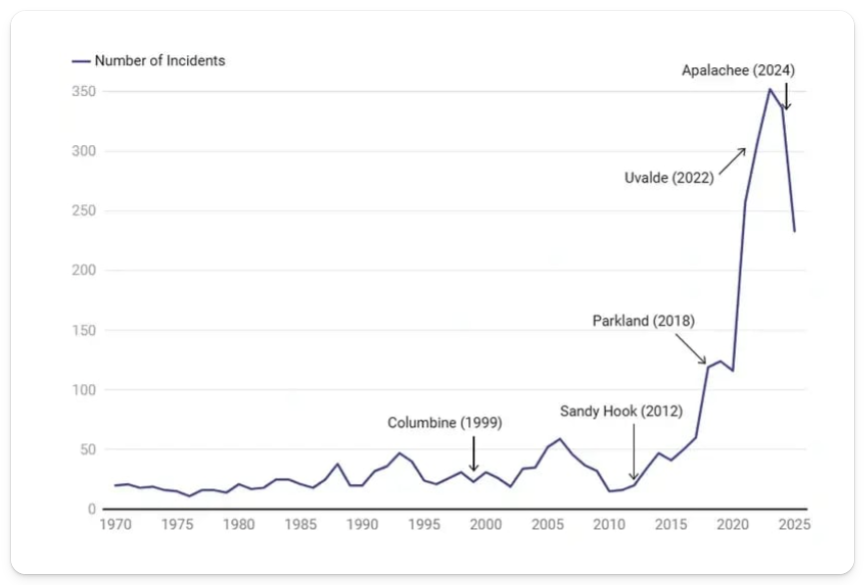
In the aftermath of the Columbine High School massacre in 1999, the United States made a decision that felt obvious, urgent, and responsible: make schools physically safer. Over the next two decades, federal, state, and local governments poured billions of dollars into security infrastructure, e.g. metal detectors, surveillance cameras, hardened doors, armed officers, controlled-entry systems, ballistic backpacks, and active-shooter drills.
Yet a quarter century later, the uncomfortable truth is hard to ignore: these investments have not meaningfully reduced the frequency or lethality of school shootings. Despite widespread adoption of security hardware and personnel, the number of shooting incidents on school grounds has not declined.
Federal data indicate that school shootings resulting in injury or death reached record levels in recent years.
A Physical Security Failure
After Columbine, policymakers treated school shootings primarily as a physical security failure. The solution, therefore, was to add layers of defense: barriers, visibility, and force.
Schools increasingly resembled airports or correctional facilities, especially in low-income districts. But unlike airports, schools are open social systems, not controlled environments.
Students are known to one another. Shooters are often insiders. The threat rarely arrives as an external intruder breaching a perimeter; it emerges from within the community. Traditional security spending has created a false sense of protection while failing to prevent incidents and fatalities. This represents not just wasted money but wasted opportunity—resources that could have been invested in AI-powered prevention. Instead, these resources are funding reactive measures with proven ineffectiveness.
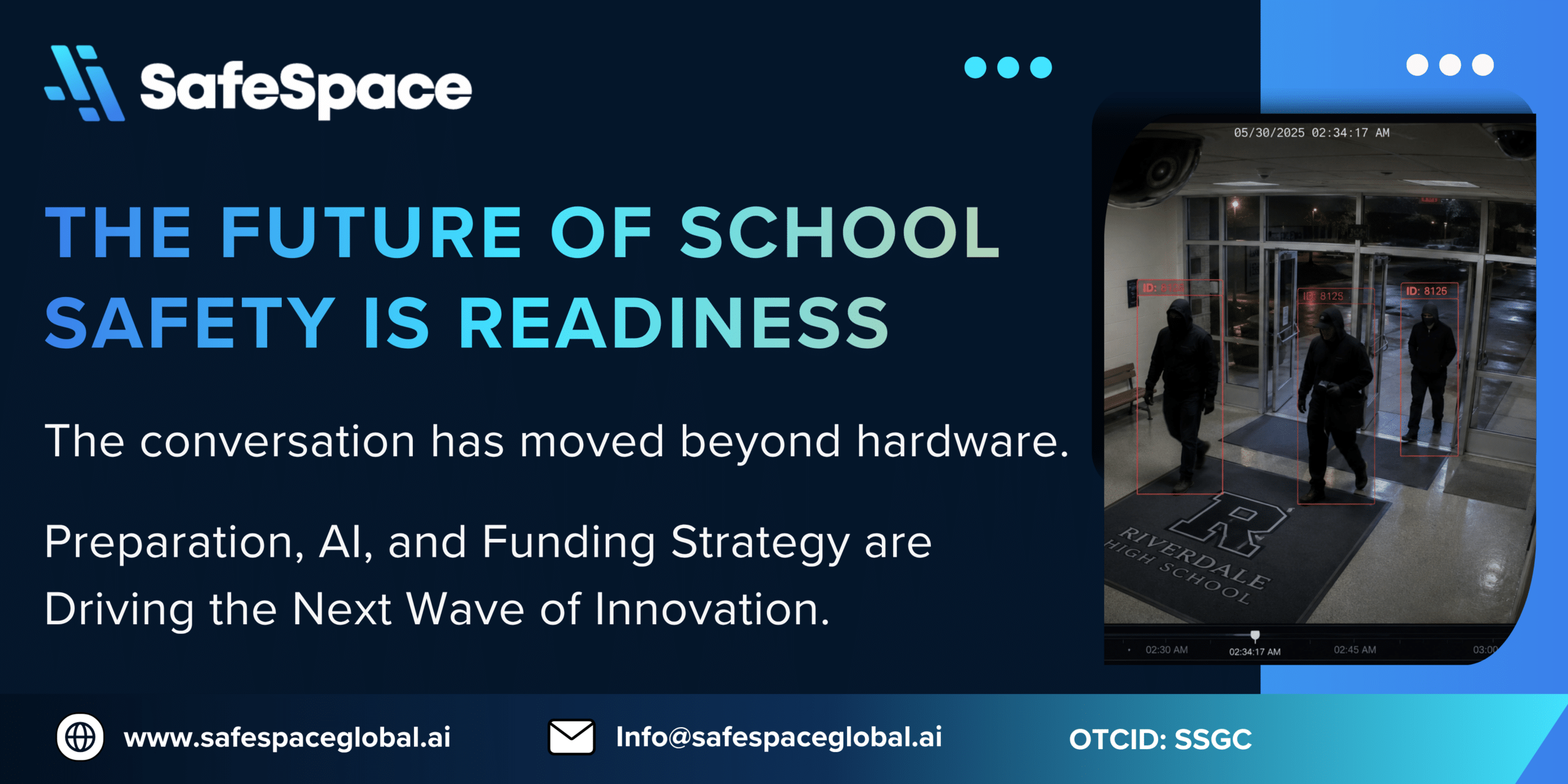
School shootings are not primarily a failure of locks, doors, or cameras. They are a failure of early detection, connection and proactive intervention long before the first shot is fired.
An Explosion of School Security Spending
Following Columbine, school security became an industry. According to a report from the Center for American Progress, federal and local spending on school security technology and services now totals billions annually, with the school security industry worth at least $2.7 billion per year*. Federal programs, including grants under the Department of Justice and Department of Education, have incentivized hardware purchases and policing
strategies intended to fortify campuses.
Nearly all U.S. public schools now use multiple security measures: controlled access, surveillance cameras, and active shooter plans are commonplace. For example, nationwide data show that over 90% of schools have written active shooter response plans, locked doors, and some form of access control*.
School resource officers (SROs) and armed security guards illustrate this uncertainty. A 2023 study in the Journal of Policy Analysis and Management found that while SROs reduced some forms of non-gun-related violence, there was no discernible reduction in overall violent incidents, and reports of firearm offenses were higher—likely because the officers were detecting and reporting guns more often.
Integrated SafeSchool ™ Threat Prevention Platform
On a mission to help save lives, SafeSpace Global Corporation (OTCID:SSGC) recently announced the execution of a non-binding Letter of Intent (“LOI”) with Base MolecularResonance ™ Technologies (BMRT) to pursue the formation of a joint venture focused on the deployment of molecular-level weapons detection technology across K–12 schools and correctional facilities in the United States.
The contemplated joint venture would integrate BMRT’s molecular detection sensors with SafeSpace Global’s existing multimodal AI platform and its emergency response integration partner, 911inform, to deliver SafeSpace SafeSchool ™ , a layered threat-prevention architecture designed to enhance situational awareness and response coordination.
The proposed system would operate through four integrated phases:
- Perimeter Detection (BMRT):
Molecular resonance sensors designed to detect potential weapon-related molecular signatures at extended distances, including within moving vehicles. - AI-Based Correlation (SafeSpace Global):
Multimodal AI analysis incorporating license plate recognition, facial recognition, and object classification to assist in threat assessment. - Human-in-the-Loop Verification:
Real-time alerts delivered to authorized personnel for review prior to automated escalation. - Emergency Response Integration (911inform):
Coordinated emergency notifications, location data sharing, and response workflows following threat
validation.
This approach is intended to complement, not replace, existing physical security, law enforcement, and emergency response protocols.
What Evidence Suggests Moving Forward
A growing body of experts argue that prevention, not just fortification, holds greater promise. Programs that focus on mental health services, threat assessment teams, student support systems, and early intervention have demonstrated more consistent links to improved school climate and may help address the roots of violence before it occurs.
Threat assessment teams, now present in roughly two-thirds of U.S. schools, shift the focus from reacting to a threat to proactively understanding and intervening in student behavior.
Leading the charge in this new approach is SafeSpace Global. With its facial and license plate recognition, weapons detection and behavioral use cases, SafeSpace’s AI platform prevents incidents, instead of just responding to them, delivering ROI measured in saved lives, not just dollars spent.
Contact us today to learn more about how we are helping to save lives.
*Sources:
https://safespaceglobal.ai/media/
https://k12ssdb.org/
https://www.americanprogress.org/article/smart-investments-safer-schools/
https://nces.ed.gov/fastfacts/display.asp?id=954
http://bit.ly/3KXSB4H