School Safety Expectations Have Changed
There was a time when school safety measures such as visitor sign-in procedures, fire suppression systems, security cameras, and locked exterior doors were considered optional enhancements.
Today, they are standard operating procedures.
The same evolution is occurring with weapons detection and entry screening.
As school safety threats continue to evolve, policymakers, educators, parents, and first responders are increasingly recognizing that preventing a weapon from entering a school is more effective than responding after it is already inside.
Georgia’s HB268 reflects that shift in thinking. By establishing requirements for mobile panic alert systems, digital floor mapping, connected emergency response, the legislation signals a broader reality: a comprehensive solution is becoming a baseline expectation for school safety.
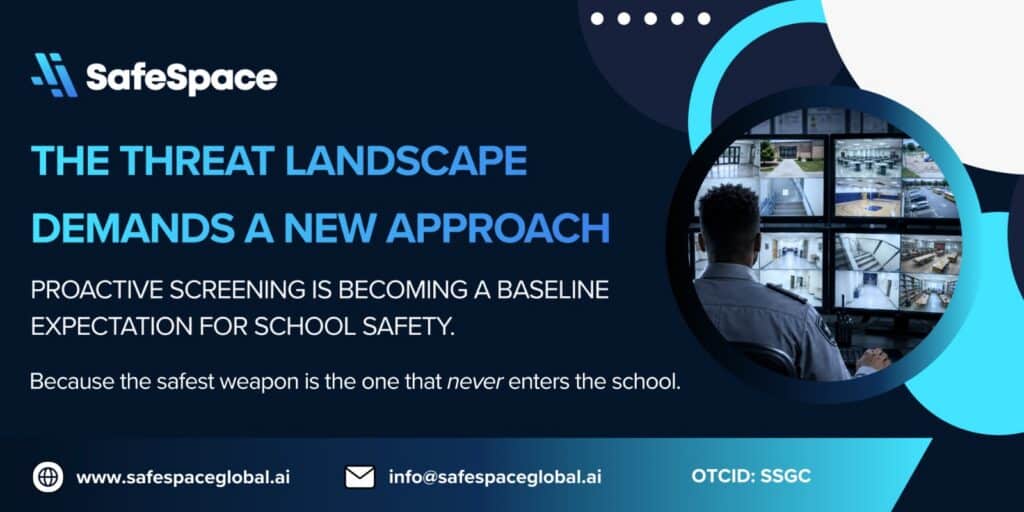
The Threat Landscape Demands a New Approach
The need for preventative safety measures has never been greater.
According to the K-12 School Shooting Database, firearm-related incidents on school grounds have increased more than 300% over the past decade.
At the same time, RAND’s 2025 American School District Panel survey found that 43% of principals reported at least one threat made against their school during the previous two school years.
For school leaders, these statistics represent more than numbers.
They represent growing operational, legal, and governance responsibilities.
School boards and administrators are increasingly expected to demonstrate not only that they have safety plans in place, but that they are taking reasonable steps to prevent threats from entering campus in the first place.
Prevention Is More Effective Than Response
Historically, many school security investments have focused on response.
Alarms notify staff.
Cameras record events.
Emergency plans activate after a threat is identified.
While these measures remain essential, they often address the problem after a weapon has already entered the building.
The reality is simple:
The safest weapon is the one that never enters the school.
AI-powered screening systems fundamentally change the equation by identifying potential threats before students, staff, and visitors enter occupied areas.
Rather than reacting to an incident, schools gain the ability to prevent one.
Why AI-Powered Screening Matters
Modern screening technologies are no longer limited to traditional metal detectors that create bottlenecks and operational challenges.
Today’s AI-powered systems can help schools:
- Screen large volumes of students and visitors efficiently
- Detect potential weapons in real time
- Reduce entry delays and congestion
- Alert designated personnel immediately
- Support faster, more informed response decisions
Most importantly, they help eliminate the critical delay between a weapon entering a building and the moment school personnel become aware of the threat.
In a crisis, that delay can have life-altering consequences.
The New Standard of Care
School leaders routinely evaluate risks associated with transportation, facilities, emergency preparedness, and student welfare.
The question is no longer whether technologies exist to improve campus safety.
They do.
The question is whether schools can justify not implementing available tools that reduce risk and improve threat prevention.
As legislation like Georgia’s HB268 gains attention nationwide, implementation of specific safety and emergency measures is increasingly becoming part of what responsible school operations look like.
Just as seatbelts became standard in vehicles and fire suppression systems became standard in buildings, routine weapons screening is emerging as a foundational component of modern school safety.
Looking Ahead
The future of school safety will not be defined by how quickly schools react to threats.
It will be defined by how effectively they prevent them.
At SafeSpace Global, we believe safety begins before an incident occurs. Through multimodal AI and intelligent screening technologies, schools can move beyond reactive security measures and toward proactive protection, helping administrators, principals, school boards, and first responders identify threats earlier, respond faster, and create safer learning environments for every student and staff member.
Because when it comes to school safety, the goal should never be responding to a weapon inside a building.
The goal is ensuring it never gets there in the first place.
Sources:
https://www.cisa.gov/topics/school-safety
https://www.legis.ga.gov/legislation/66418
https://www.rand.org/education-and-labor/projects/asdp.html
https://k12ssdb.org