We are excited to announce that HiTC is now SafesSpace. We have have also updated our stock to OTC: SSGC.

AUTHOR

DATE

SHARE

A promotional graphic for SafeSpace highlights multimodal systems with surveillance camera feeds and the text, "Multimodal isn’t an upgrade, it’s a shift.

Multimodal Proof Points: Why One Sensor Is No Longer Enough

Detection systems that rely on a single modality (like vision alone) miss critical context. Combining modalities, (e.g. vision, radar, LiDAR, and audio), reduces uncertainty and materially improves detection accuracy and reliability.

Why This Matters

A camera sees what things look like.
A radar sees how things move.
A LiDAR sees where things are in 3D space.

Individually, each fails in predictable ways:

  • Cameras struggle in low light, fog, or glare
  • Radar lacks fine detail
  • LiDAR can be sparse or noisy

Multimodal systems combine these strengths, so when one fails, another fills the gap.

This is the core principle of sensor fusion, which reduces uncertainty and produces “more accurate, complete, and dependable” outputs than any single sensor alone.

Accuracy & Reliability Gains

Multimodal does not equal incremental improvement; it often equals the difference between detection and failure.

  • A 2026 study combining camera, LiDAR, and radar achieved ~95% mean average precision (mAP) for object detection, outperforming individual modalities and maintaining stability across conditions.
  • Radar alone showed lower accuracy (~33.9% mAP), but contributed critical robustness in adverse environments (e.g., poor visibility).
  • Fusion systems consistently match or exceed the strongest individual sensor while reducing variance and failure cases.
  • Research consensus: multimodal fusion improves accuracy, robustness, and failure recovery by leveraging complementary signals.

Bottom line:

Single-modality systems optimize for best-case scenarios.

Multimodal systems optimize for reality.

SIDE-BY-SIDE: Vision vs. Multimodal Detection
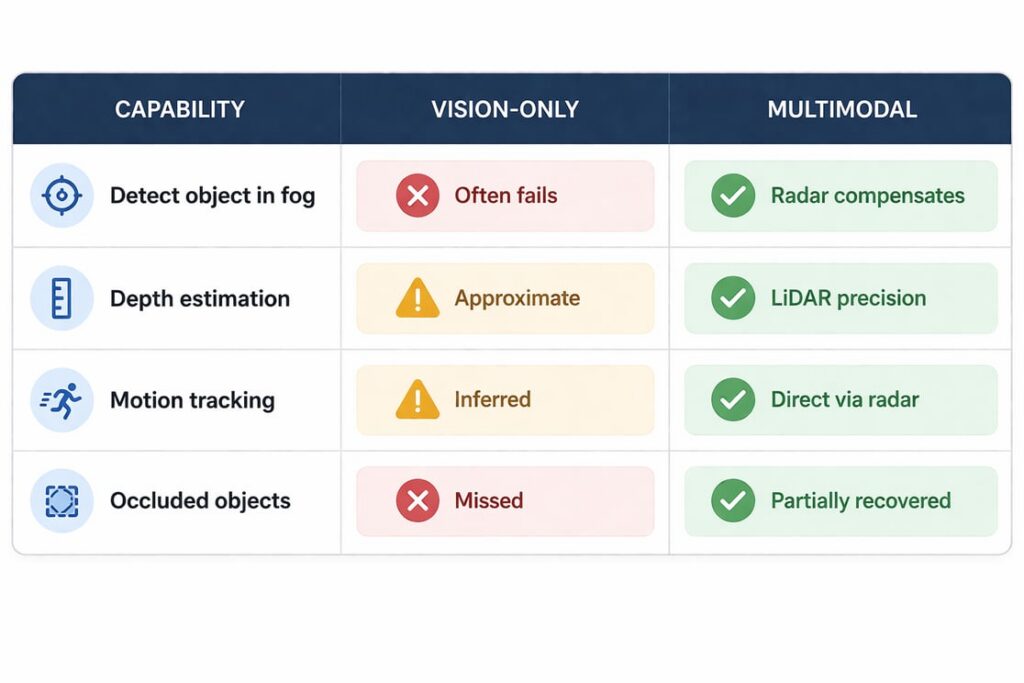
Comparison table showing detection capabilities of vision-only vs. multimodal sensors in fog, depth estimation, motion tracking, and occluded objects, with multimodal outperforming vision-only.

Upload inline_1.jpeg to your WordPress Media Library and place it here.

Multimodal systems don’t just improve accuracy; they recover detections that would otherwise be lost entirely.

This is why modern perception stacks are shifting toward multi-sensor architectures by default.

The most compelling KPI isn’t just “higher accuracy”; it’s fewer missed detections when conditions degrade.

If your detection stack depends on a single modality, you’re optimizing for ideal conditions, not real ones.

Multimodal Isn’t an Upgrade, It’s a Shift

In real-world environments, failures don’t show up as errors, they show up as absences.

The shift to multimodal isn’t about adding sensors; it’s about building systems that fail less often.

Multimodal systems aren’t about seeing more. They’re about missing less, when it matters most.

And in detection systems, what you miss matters more than what you see.

Multimodal isn’t a feature you add. It’s the new baseline you design around.

SafeSpace recognized this shift early and is leading the way with its multimodal AI technology. Together, let’s build a system that holds up when accuracy matters most.

Sources:
https://www.nature.com/articles/s41598-025-32588-5
https://www.emergentmind.com/topics/multi-modal-sensor-fusion

RELATED ARTICLES

A man monitors multiple security camera feeds in a control room. Text: "School safety expectations are rising, and the conversation has changed." SafeSpace branding and contact info.

The Technology Is Ready. The Funding Exists.

What’s Missing Is Urgency. For years, school districts have cited two reasons for delaying advanced safety initiatives: technology readiness and...

A security professional monitors multiple surveillance screens in a control room. Text promotes proactive screening for school safety by SafeSpace. Contact information and OTCID are shown.

Routine Screening Is The New Standard of Care

School Safety Expectations Have Changed There was a time when school safety measures such as visitor sign-in procedures, fire suppression...

Security personnel monitor multiple live camera feeds on computer screens in a control room. Text highlights the goal of prompt threat detection and response. SafeSpace branding is visible.

The Critical Gap That Costs Lives: Detection Isn’t Enough

School safety conversations often center on threat detection: identifying weapons, recognizing suspicious behavior, or spotting potential threats before they escalate. But...

A promotional banner for SafeSpace emphasizes early threat detection and communication for school emergency preparedness, featuring images of surveillance monitors and school security.

Detection Before Entry Changes Everything: Shifting Toward Prevention

For decades, school security strategies have focused on responding to threats after they enter the building. But in today’s threat...

A digital poster by SafeSpace highlights evolving school safety threats, featuring a security camera view of students in a hallway with digital monitoring graphics.

The Threat Landscape Has Changed: School Safety Must Evolve With It

The Threat Is Real, And It’s Evolving School safety threats in 2026 look very different than they did a decade...

A promotional SafeSpace graphic compares surveillance with situational awareness, showing security monitors and a uniformed officer, and includes contact information and a web address.

AI Physical Safety Is Not Surveillance; It’s Situational Awareness: ‘Watching’ versus ‘Informing’

Differentiating Between Surveillance & Situational Awareness One of the most important distinctions in today’s school safety conversation is the difference...

A promotional graphic for SafeSpace highlights multimodal systems with surveillance camera feeds and the text, "Multimodal isn’t an upgrade, it’s a shift.

Our mission is to help save lives. This is our guiding principle in all we do, and we would love to partner with you. Contact us today for a complimentary consultation.

QUICK LINKS